
Mental Health ADvocacy
Let’s talk about suicide.
I’ve heard friends call it the “s” word that no one wants to mention. It’s hiding, like the monsters my child mind knew lived under the bed, waiting to grasp my ankles. Is it less real if we don’t talk about it? No.
Let’s make the unreal real and save lives.
Societal change starts with societal discussions.
Suicide is a complex problem that involves both mental health risks and societal ones. Many people who attempt to take their own lives either do not have a mental illness, or are not yet diagnosed. If we rely on mental health treatment resources to prevent suicide, we’re never reaching the 1 in 5 people who attempt before they seek care. The 11th leading cause of death in the United States is suicide.
Every 11 minutes
someone dies by suicide
13 million
people make serious plan each year
11th
leading cause of death
1 in 5
who attempt have no
mental health diagnosis
“I’m crazy,” I said to myself.
Crazy can’t be escaped. Crazy is unacceptable. Crazed, I might as well give up because I can’t understand the world and the world can’t understand me.
But that day I paused as depression and euphoria mixed like water and oil in a lava lamp: “What if those things are true? Why is crazy bad?”
Maybe, instead of accepting that I don’t belong, I need to tell the world how I do. I can, after all, teach people how to treat me.
Brooke Walsh
|
expert from her book Unreal
Hi, I’m your friendly, neighborhood suicidal person.
My story is one of trauma and rebirth.
With this life I am still living, I will keep talking. And I’d love to have you join me in this unreal movement.
For years I had no path mental health diagnosis or treatment. In 2022 my body and mind could not handle it anymore. I made a series of suicide attempts in secret. Each time lying to myself that it wasn’t “a big deal.” This taught my brain to be less afraid of making another attempt, what we call acquired capability.
By fall of that year my mind broke into so many pieces it took 10 months of intensive treatment over the course of 20 to keep me alive. And during that time I made more attempts — due to medication manias, unstable depressions, and a deep hopelessness I never thought I could escape.
This book is Unreal.
I’m an open book, literally — my book Unreal is in process.
It is, at once, a love letter to my child self and what I hope is an example that you can stay here with us.
It delicately weaves personal narratives with practical reflections about the tools I have used to stay alive. I dig into what humane, trauma informed treatment has grown to look like for me.
Reaching out for help has not been my strong suit, partly because I didn’t know what to ask for or how to do it. It’s my hope this story helps suicidal people and their loved ones understand what the journey to stay alive can look like and how to talk to each other about it.
Safety Menu
A friend struggled: “I don’t know how to ask for help, or what I want.” This menu was born in response.
Use it to easily reference ways to ask for help, coping techniques, and crisis hotlines to call. The pdf has workable links for the crisis hotlines.
Safety Bottom Lines
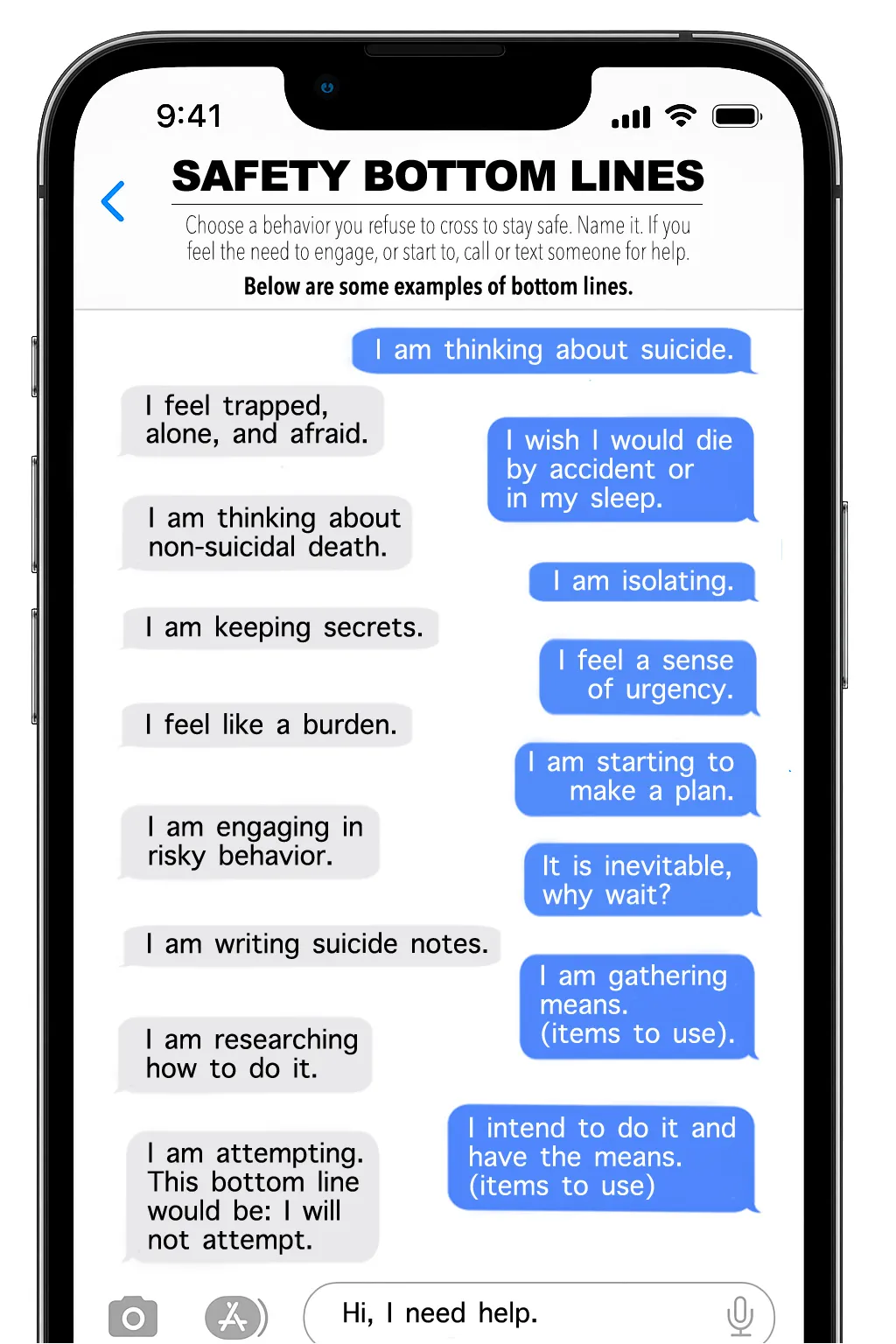
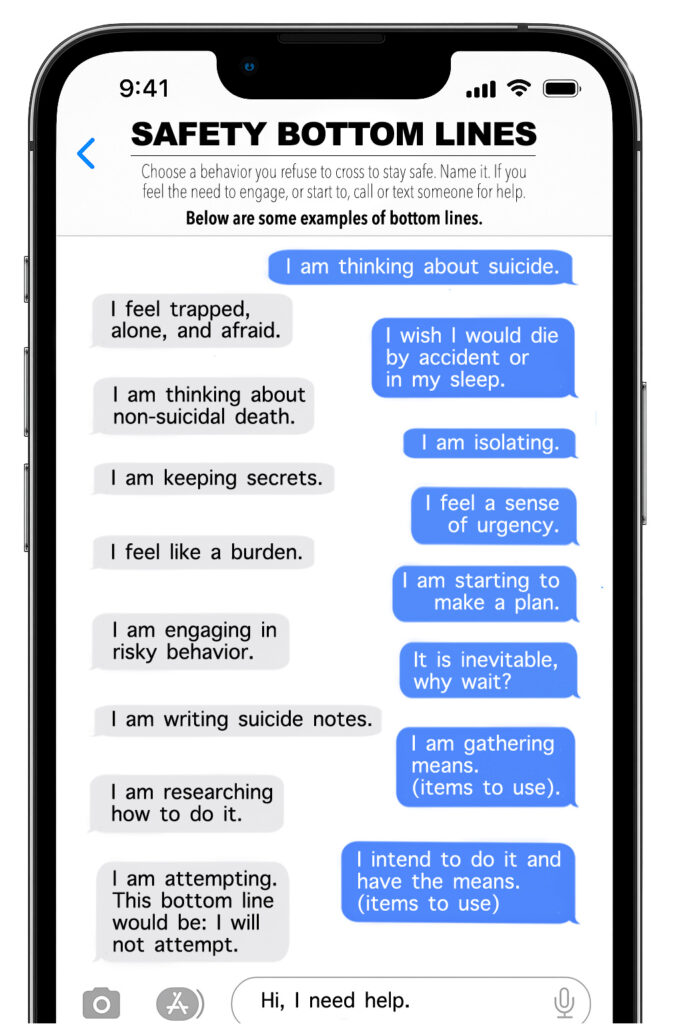
Staying alive is hard. Reaching out to people for help is hard. Deciding when to reach out? Hard.
The bottom line system takes the guess work out of when to reach out.
Choose a behavior that you refuse to cross. If you feel like doing it, or are starting to, reach out for help.
Anti-Suicide Document
It’s a document of what support I want. I give this to the people helping me.
It outlines what care I consent to, specific things that are helpful to me, and what signs mean I need it.
This book includes examples, and a side story that evolves through dispatches which illustrates the crisis situations and helpful responses.